Exploring Marketing Mix Modeling with Google Meridian
July 7, 2026 / Marketing Analytics
I've been exploring different ways to measure marketing performance beyond traditional attribution models, and one tool that caught my attention is Google Meridian.
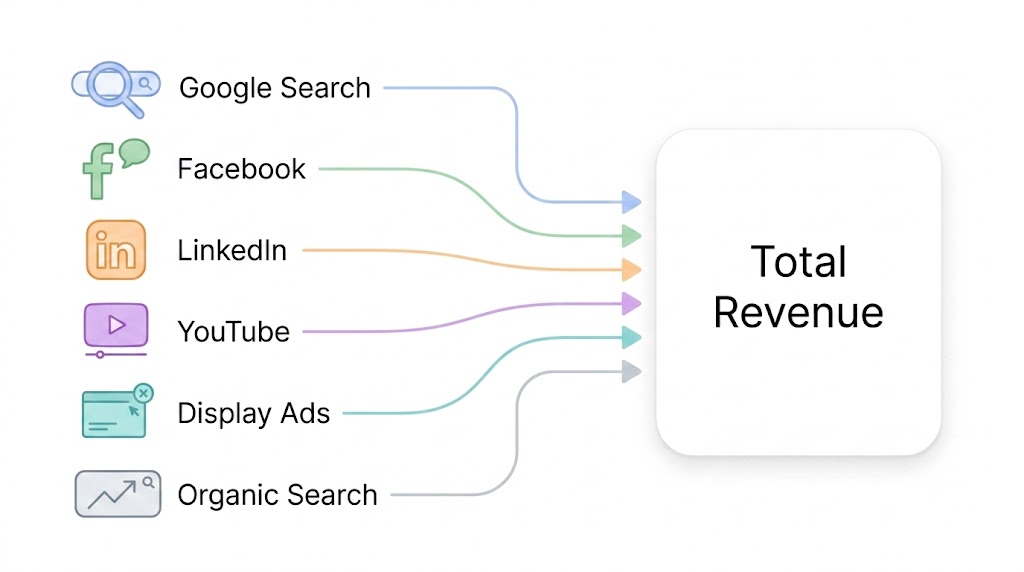
Unlike attribution, which follows individual user journeys, Meridian uses Marketing Mix Modeling (MMM) to estimate how much each marketing channel contributes to overall revenue. Instead of asking "Which channel got the last click?", it asks "How much incremental revenue did this channel generate?"
[image: Simple diagram showing multiple marketing channels contributing to total revenue]
Building the model
I used my own marketing data, including weekly revenue, media spend by channel, and a couple of organic metrics.
One important thing I added was two variables representing major product changes that happened during the year. Those changes had a noticeable impact on conversion rates, and I wanted the model to separate product-related effects from marketing performance.
From there, the process was fairly straightforward:
- Prepare the dataset.
- Configure the Meridian model.
- Generate an Exploratory Data Analysis (EDA)
- report.Fit the Bayesian model.Run convergence and health checks.
- Generate the final HTML report.
The notebook does a great job of guiding you through each step.
What the report showed
The final report estimates each channel's contribution to revenue, compares spend against revenue contribution, and provides estimated ROI for every marketing channel.
One result immediately stood out: Facebook appeared to contribute significantly more revenue than I expected.
The interesting part
This is where things became interesting.
When I look at our internal BI dashboards, Facebook is associated with very little revenue. Meridian, however, suggests Facebook contributes much more to overall business performance.
At first glance, those results seem contradictory.
But they're actually answering different questions.
Our BI reports focus on user-level attribution: who visited the site and where they came from. Meridian looks at the bigger picture and estimates how changes in media spend affect total revenue over time. It's measuring incremental impact, not simply assigning credit for conversions.
How much should I trust it?
I wouldn't treat the numbers as absolute truth, but I also wouldn't ignore them.
The model converged successfully, passed the health checks, and I included major product changes so they wouldn't be incorrectly attributed to marketing channels. That gives me confidence that the results are directionally meaningful.
The next step is to validate the results. I'll keep feeding the model with new data and see if these results stay consistent over time.
Marketing Mix Modeling isn't a replacement for attribution. It's another lens for understanding marketing performance. Used together, the two approaches can provide a much more complete picture than either one on its own.